Wife Grace Nail Johnson
Queer Places:
Green-Wood Cemetery, Brooklyn, Kings County (Brooklyn), New York, USA
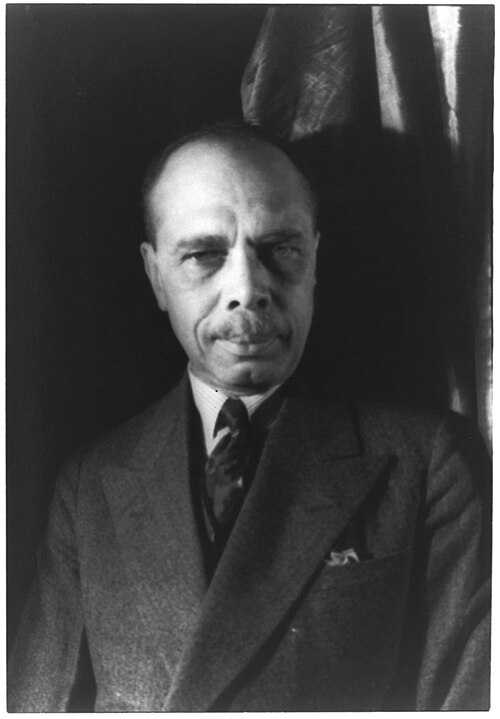 James Weldon Johnson (June 17, 1871 - June 26, 1938) was born on June 17, 1871, in Jacksonville, Florida, to James Johnson, a biracial headwaiter, and
Helen Louise Dillet, a musician and the first African American female teacher in Florida. Educated initially by his mother, he completed his preparatory
and collegiate studies at Atlanta University, earning his bachelor's degree with honors in 1894 and later a master's degree in 1904. Returning to
Jacksonville, he served as the principal of the Stanton School, expanding its curriculum to higher grades to extend educational access for Black
students. During this period, he founded and edited the Daily American newspaper in 1895 and, through self-study, became the first African American
admitted to the Florida Bar through open examination in 1897.
James Weldon Johnson (June 17, 1871 - June 26, 1938) was born on June 17, 1871, in Jacksonville, Florida, to James Johnson, a biracial headwaiter, and
Helen Louise Dillet, a musician and the first African American female teacher in Florida. Educated initially by his mother, he completed his preparatory
and collegiate studies at Atlanta University, earning his bachelor's degree with honors in 1894 and later a master's degree in 1904. Returning to
Jacksonville, he served as the principal of the Stanton School, expanding its curriculum to higher grades to extend educational access for Black
students. During this period, he founded and edited the Daily American newspaper in 1895 and, through self-study, became the first African American
admitted to the Florida Bar through open examination in 1897.
In 1899, Johnson shifted his focus toward creative pursuits, collaborating with his younger brother, composer J. Rosamond Johnson, and songwriter Bob
Cole in New York City. Together, they formed a highly successful Broadway songwriting trio, producing roughly 200 songs that helped dismantle crude
racial stereotypes in popular sheet music. During this era, Johnson penned the lyrics to "Lift Ev'ry Voice and Sing" to honor Booker T. Washington, set
to music by his brother, which became widely embraced as the Black National Anthem.
Entering public service, Johnson served as president of the Colored Republican Club and supported Theodore Roosevelt's 1904 campaign. Roosevelt
appointed him U.S. consul to Puerto Cabello, Venezuela, in 1906, and later to Corinto, Nicaragua, where he served from 1909 to 1913. His diplomatic
tenure afforded him the time to write his seminal novel, The Autobiography of an Ex-Colored Man, published anonymously in 1912, as well as poetry
published in prominent national journals. In 1910, he married civil rights activist Grace Nail. Upon
returning to New York, he served as the editorial page editor for The New York Age, utilizing his platform to critique racial violence and advocate for
civil rights.
Johnson joined the National Association for the Advancement of Colored People (NAACP) in 1916 as a field secretary and organizer, reviving Southern
chapters and leading major national demonstrations, such as the 1917 Silent Protest Parade in New York City. In 1920, he was named the first Black
executive secretary of the NAACP, serving as its chief operating officer until 1930. Under his leadership, the organization mounted legal challenges
against disenfranchisement, investigated the brutal conditions of the U.S. occupation of Haiti, and aggressively lobbied for federal anti-lynching
legislation, particularly following the period of racial violence he named the "Red Summer" of 1919.
Throughout the 1920s, Johnson stood at the center of the Harlem Renaissance as a poet, critic, editor, and mentor. He compiled foundational
anthologies, including The Book of American Negro Poetry (1922) and The Book of American Negro Spirituals (1925), and authored his celebrated verse
collection God's Trombones (1927) alongside his 1930 sociological study Black Manhattan. Following his leadership at the NAACP, he returned to academia
in 1930 as the Spence Chair of Creative Literature at Fisk University, and in 1934 became the first African American professor hired at New York
University. He published his autobiography, Along This Way, in 1933. On June 26, 1938, Johnson died at age 67 when a train struck the car his wife was
driving during a heavy rainstorm in Wiscasset, Maine.
While Johnson lived in a public, heterosexual marriage with Grace Nail Johnson, his life and legacy intersect significantly with LGBTQ history and
historiography. During the Harlem Renaissance, Johnson served as an essential institutional builder and creative mentor within Harlem’s artistic
ecosystem, which was heavily driven and shaped by queer Black intellectuals and artists, including
Alain Locke, Langston Hughes,
Countee Cullen, and Carl Van Vechten, who frequently
photographed and documented both James and his brother Rosamond. Modern scholarship on early twentieth-century African American culture directly examines
how the creative partnerships, literary salons, and theatrical networks fostered by figures like the Johnson brothers blurred the boundaries between
queer and heterosexual creative circles, placing their collaborative work alongside the foundational queer vanguard of the Harlem Renaissance.
References:
Other references:
- James Weldon Johnson Papers – Beinecke Rare Book and Manuscript Library, Yale University: The central archival repository housing Johnson’s personal correspondence, drafts, photographs, legal papers, and organizational records.
- NAACP Records (1916–1930) – Library of Congress (Manuscript Division): Documents Johnson’s tenure as Field Secretary and Executive Secretary, including records on anti-lynching campaigns, membership expansion, and the investigation into the U.S. occupation of Haiti.
- Fisk University Special Collections – Fisk University Library: Holds papers and university records pertaining to Johnson's tenure as the Spence Chair of Creative Literature.
- National Archives and Records Administration (NARA) – Consular Despatches and Records of the Foreign Service: Documents Johnson’s diplomatic career as U.S. Consul to Puerto Cabello, Venezuela, and Corinto, Nicaragua (1906–1913).
- Johnson, James Weldon. The Autobiography of an Ex-Colored Man. Anonymous publication, 1912; republished under his name, 1927.
- Johnson, James Weldon. Fifty Years and Other Poems. Cornhill Company, 1917.
- Johnson, James Weldon, ed. The Book of American Negro Poetry. Harcourt, Brace and Company, 1922.
- Johnson, James Weldon, and J. Rosamond Johnson, eds. The Book of American Negro Spirituals. Viking Press, 1925.
- Johnson, James Weldon. God's Trombones: Seven Negro Sermons in Verse. Viking Press, 1927.
- Johnson, James Weldon. Black Manhattan. Alfred A. Knopf, 1930.
- Johnson, James Weldon. Along This Way: The Autobiography of James Weldon Johnson. Viking Press, 1933.
- Johnson, James Weldon. Negro Americans, What Now? Viking Press, 1934.
- Fleming, Robert E. James Weldon Johnson. Twayne Publishers, 1987.
- Levy, Eugene. James Weldon Johnson: Black Leader, Black Voice. University of Chicago Press, 1973.
- Price, Kenneth M., and Lawrence J. Oliver, eds. Critical Essays on James Weldon Johnson. G.K. Hall & Co., 1997.
- Ruotolo, Christine, et al. James Weldon Johnson: Writings. Library of America, 2004.
- Lewis, David Levering. When Harlem Was in Vogue. Alfred A. Knopf, 1981.
- Schwarz, A. B. Christa. Gay Voices of the Harlem Renaissance. Indiana University Press, 2003.
- Vogel, Shane. The Scene of Harlem Cabaret: Race, Sexuality, and Performance. University of Chicago Press, 2009.
Support this project
This website is a passion project researched, developed, and funded entirely by me. If you find the content valuable and would like to help support the ongoing research and hosting costs, any contribution is deeply appreciated.
Thank you for keeping this independent resource alive!
My books on Amazon: Elisa Rolle's books
BACK TO HOME PAGE
